
What "FDA-Approved" Really Means. Not a Safety Guarantee.

Key Takeaways
"FDA-approved" is a benefit-risk decision, not a safety guarantee. It means the agency judged a drug's benefits to outweigh its known risks for one specific use — based on the evidence available at approval.
Surprising substances are FDA-approved right now: Fentanyl, pharmaceutical methamphetamine (Desoxyn), botulinum toxin (Botox), and cocaine (Goprelto) — because each has a legitimate, tightly controlled medical use.
Some approved drugs were later pulled after harms surfaced in wider use — among them Vioxx (2004), Belviq (2020), and Zantac/ranitidine (2020).
Roughly one in three new drugs approved between 2001 and 2010 had a post-market safety event, per a 2017 study in JAMA — a reminder that real-world safety keeps being learned after approval.
Dietary supplements are not FDA-approved before sale, so "FDA approved" and "natural" are both incomplete answers. The smartest move is informed, individualized care — not blind trust or blanket fear.
You see the phrase everywhere: on packaging, in commercials, in the fine print. "FDA approved." For most of us it lands like a stamp of total safety — proof that experts checked the box and there's nothing left to worry about.
The reality is more useful, and a little more humbling. FDA approval is a meaningful signal. It's also frequently misunderstood. Knowing what it actually certifies — and what it doesn't — helps you ask better questions, weigh real trade-offs, and make calmer decisions about your own care.
At Harmony Health Clinic in Naples, we see this play out constantly, especially each winter as snowbirds arrive carrying medication lists from several out-of-state doctors. This article breaks down what the label really means, walks through some eyebrow-raising examples, and explains how to think about it all without fear.
What does "FDA-approved" actually mean?
When the U.S. Food and Drug Administration approves a new drug, its scientists review the manufacturer's clinical trial data and make one core judgment: do the benefits outweigh the known and potential risks for the intended population? According to the FDA's own consumer guidance, the agency interprets the word "safe" to mean exactly that — benefits outweighing risks — not "risk-free."

In plain terms: FDA-approved means the FDA-reviewed a drug's clinical data and decided its benefits outweigh its known risks for one specific use. It is a benefit-risk judgment made at a point in time — not a promise that the drug is safe for everyone, free of side effects, or risk-free forever.
"Approved" is a verdict on the evidence available that day
Approval reflects what was known at the moment of the decision. Clinical trials typically involve a few thousand carefully selected participants over a limited window. Once a drug reaches millions of real people — older, sicker, on other medications, taking it for years — new patterns can emerge that trials were never big or long enough to catch. That's not a scandal; it's a structural limit of how testing works.
Approval is tied to a specific use
A drug is approved for a defined indication, dose, and population — what's printed on the label. The same medicine used differently (a different condition, a higher dose, a patient type that was never studied) is operating outside what the FDA actually evaluated. The approval doesn't automatically stretch to cover it.
What surprising things are FDA-approved right now?
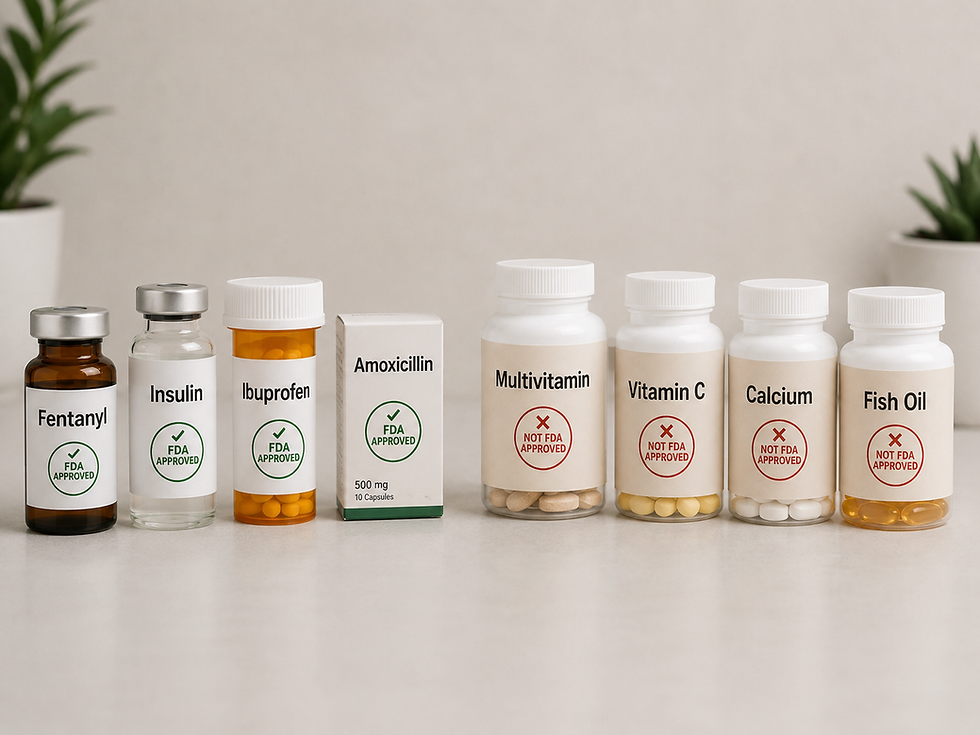
If "FDA approved" simply meant "harmless," the current list of approved drugs would look very strange. Consider a few examples — all legal, all prescribed, all genuinely useful in the right hands:
Fentanyl
The same opioid driving headlines about overdose is also an FDA-approved prescription medication. As the Duragesic patch and other forms, fentanyl is a Schedule II drug approved to manage severe, persistent pain in patients who are already opioid-tolerant — for example, in advanced cancer. It's powerful, dangerous if misused, and legitimately approved.
Pharmaceutical methamphetamine
Methamphetamine has an FDA-approved form, sold as Desoxyn, used for ADHD and short-term weight management when other options have failed. The DEA notes it's the only legal methamphetamine product. Same molecule as the street drug; very different context, dose, and oversight.
Botulinum toxin (Botox)
Botox is a purified, diluted form of botulinum toxin — described in the medical literature as one of the most poisonous biological substances known. It carries the FDA's most serious "boxed" warning, yet it's approved and widely used for migraines, muscle spasticity, certain eye disorders, and cosmetics.
Medical cocaine
Cocaine has an approved pharmaceutical version too — Goprelto, a cocaine hydrochloride nasal solution the FDA approved in December 2017 as a local anesthetic for certain nasal procedures.
The point isn't that these drugs are bad. The point is that FDA approval certifies a favorable benefit-risk balance for a defined use — not harmlessness. A potent or even toxic substance can be the right tool for the right patient under the right supervision. That nuance is the whole game.
Which FDA-approved drugs were later found dangerous?
Approval is the beginning of a drug's safety story, not the end. A few well-documented cases show why ongoing vigilance matters.
Vioxx (rofecoxib)
Approved in 1999 as an arthritis and pain reliever, Vioxx was taken by more than 80 million people before Merck withdrew it in 2004 over an increased risk of heart attacks and strokes. Writing in the New England Journal of Medicine, cardiologist Eric Topol called it the largest prescription-drug withdrawal in history. A later analysis in The Lancet by FDA scientist David Graham estimated tens of thousands of excess cardiovascular events over the drug's market life.
Belviq (lorcaserin)
A weight-loss drug approved in 2012, Belviq was withdrawn in 2020 after a five-year trial in more than 12,000 patients showed a higher rate of cancer among those taking it. (If you're weighing options here, our look at the truth about semaglutide and weight loss covers how we think about today's popular medications.)
Zantac (ranitidine)
The familiar heartburn drug had been on shelves since the 1980s. In April 2020 the FDA requested removal of all ranitidine products after determining they could contain rising levels of NDMA, a probable human carcinogen, over time and in heat. For root-cause alternatives, see our guide to treating reflux naturally.

How common is this? A 2017 study in JAMA tracked 222 new drugs and biologics approved between 2001 and 2010 and found that about 32% had a post-market safety event — a withdrawal, a new boxed warning, or a safety communication — over a median of nearly 12 years of follow-up. Notably, drugs that went through accelerated approval had higher rates.
Doesn't this mean the FDA is failing?
No — and this is the part that gets distorted online, so it's worth saying plainly. Most approved drugs help millions of people and never run into serious trouble. The examples above are notable precisely because they're exceptions, and in each case the safety system eventually flagged the problem.
The most famous story here actually runs the other way. In the early 1960s, FDA reviewer Dr. Frances Oldham Kelsey refused to approve thalidomide, demanding stronger safety data, even as the drug caused thousands of severe birth defects overseas. Because it was never approved here, the U.S. largely avoided that tragedy — and the episode led Congress to require proof of both safety and effectiveness before approval. (In a striking twist, thalidomide was later approved in 1998 and 2006 for leprosy complications and a blood cancer, under very strict controls — once again, a benefit-risk decision for a narrow use.)
So the honest takeaway isn't "the FDA can't be trusted." It's that approval is a careful judgment made under real-world uncertainty, and that uncertainty doesn't vanish on approval day. The system keeps learning. The wise patient keeps paying attention too.
Are supplements FDA approved?
Here's the question we get next — often from patients who've decided to avoid medications in favor of "natural" products: aren't supplements the safer, FDA-approved choice?
They're not FDA approved at all. Under the Dietary Supplement Health and Education Act of 1994, the FDA does not approve dietary supplements for safety or effectiveness before they're sold. Manufacturers are responsible for their own products, and the FDA generally steps in only after a problem appears on the market. In other words, supplements face less pre-market scrutiny than prescription drugs — the opposite of what many people assume.
That doesn't make supplements bad. It makes guidance essential. The FDA itself advises talking with a qualified provider before starting one. It's why our clinic uses third-party-tested, practitioner-selected products and matches them to your actual labs and needs — not whatever's trending. "FDA approved" and "all natural" are both shortcuts; neither replaces individualized judgment.
How should Naples patients think about "FDA approved"?
The goal isn't to fear your medicine cabinet or to swear off conventional care. Antibiotics, anesthesia, insulin, and emergency drugs are modern miracles, and FDA review is part of why. The goal is to graduate from "the box is checked, so I'm done thinking" to genuinely informed, individualized care.
That mindset is the heart of the functional medicine approach. The Institute for Functional Medicine describes it as a systems-based model focused on the root causes of disease and the whole person. Functional-medicine educator Chris Kresser frames the contrast as treating root causes versus suppressing symptoms with one prescription after another. Applied to the FDA label, it simply means asking the next questions: Why do I need this? What's the benefit-risk balance for me? Is there a root cause we could address? And how will we monitor over time?
This matters locally. Many Naples and Collier County retirees — in Pelican Bay, Old Naples, North Naples, and out to Marco Island — arrive on long, overlapping medication lists assembled by different specialists who never compared notes. Snowbird season (November–April) magnifies it, as winter residents juggle prescriptions from two states. A careful, whole-picture review is exactly where avoidable problems get caught.
One firm safety note: never stop a prescribed, FDA-approved medication on your own based on something you read — here or anywhere. Some drugs are dangerous to discontinue abruptly. Bring your questions to a licensed clinician and make changes together.
Ready to take a closer look at what's in your cabinet?
If you're in Naples and want a thorough, root-cause review of your medications and supplements — weighing benefits and risks for your body, not a population average — the team at Harmony Health Clinic is here to help. Book an appointment or explore our functional medicine services to get started.
Frequently Asked Questions
Does "FDA approved" mean a drug is completely safe?
No. FDA approval means the agency judged a drug's benefits to outweigh its known risks for a specific approved use, based on the evidence available at approval. Every drug carries some risk, and rare problems sometimes surface only after millions of people use it over time.
What are some surprising things that are FDA approved?
Several potent or even toxic substances have legitimate, tightly controlled approved uses. Examples include fentanyl for severe pain, pharmaceutical methamphetamine (Desoxyn) for ADHD, botulinum toxin (Botox) for migraines and cosmetics, and medical cocaine (Goprelto) as a local anesthetic for certain nasal procedures.
Which FDA approved drugs were later recalled?
Notable examples include Vioxx (rofecoxib), withdrawn in 2004 over heart attack and stroke risk; Belviq (lorcaserin), withdrawn in 2020 over a cancer signal; and Zantac (ranitidine), pulled in 2020 due to a probable carcinogen. A 2017 JAMA study found roughly a third of newer drugs had a post-market safety event.
Are vitamins and supplements FDA approved?
No. Under a 1994 law, the FDA does not approve dietary supplements for safety or effectiveness before they reach the market; manufacturers are responsible, and the FDA usually acts only after a problem appears. That's why third-party testing and professional guidance matter when choosing supplements.
Should I stop taking an FDA approved medication if I'm worried about it?
No — not on your own. Some medications are unsafe to stop abruptly, and abrupt changes can be more dangerous than the original concern. Share your questions with a licensed healthcare provider, who can review your full picture and adjust your plan safely.
Disclaimer: This article is for informational purposes only and does not constitute medical advice. Always consult with a licensed healthcare professional for diagnosis and treatment.


