
Medicare Fraud and the Record 2026 Takedown: How to Protect Yourself in Naples

Key Takeaways
On June 23, 2026, the U.S. Department of Justice announced one of the largest coordinated health care fraud actions on record: 455 people charged, including 90 doctors and other licensed professionals, in schemes involving more than $6.5 billion in alleged false claims — and real patient harm.
Seniors are the top target, and Southwest Florida sits in one of the most active fraud-enforcement regions in the country, which makes this especially relevant for Naples and Collier County.
Most schemes follow a few simple patterns: billing for care that was never provided, medically unnecessary tests, illegal kickbacks, and stolen Medicare numbers.
You have more power than you think. Guard your Medicare number like a credit card, read every Medicare statement, and question anything you don't recognize.
Report suspected fraud to the Senior Medicare Patrol (1-877-808-2468), Medicare (1-800-MEDICARE), or the HHS-OIG hotline (1-800-HHS-TIPS).
On June 23, 2026, the U.S. Department of Justice announced its 2026 National Health Care Fraud Takedown — a coordinated sweep that charged 455 people across 45 states and territories in schemes adding up to more than $6.5 billion in alleged false claims. Among those charged were 90 doctors, nurse practitioners, and other licensed medical professionals.
Headlines like this can feel far away. But here in Naples, this story hits closer to home than most people realize. Our community is full of retirees and snowbirds who rely on Medicare, and seniors are the number-one target of these schemes. Southwest Florida also sits within one of the busiest fraud-enforcement regions in the nation.
The good news? You are not powerless. Once you understand how these scams actually work, the warning signs become surprisingly easy to spot. This guide breaks down what happened, why it matters for Collier County, the red flags to watch for, and the simple steps that protect you and your loved ones.
What happened in the 2026 health care fraud takedown?
The Justice Department described this as a "whole-of-government" effort, and the numbers are staggering. Federal prosecutors in 56 districts, 45 states and territories, and 50 state Medicaid Fraud Control Units worked together — the most states ever to take part in a single takedown.

In plain terms: health care fraud is when a provider, company, or scammer lies to get money or services from a health program they aren't entitled to. The 2026 takedown charged 455 people in schemes worth over $6.5 billion, seized more than $182 million in cash and luxury goods, and led Medicare officials to suspend 1,079 providers and revoke billing privileges for 1,403 more.
The schemes ranged from billion-dollar billing operations to scams that preyed on hospice patients and people struggling with addiction. Investigators used data analytics to flag suspicious billing patterns, and international partners even helped return fugitives from overseas.
Most importantly, these are not victimless paperwork crimes. In one case described by the Justice Department, a medical director allegedly approved cardiac test results for student athletes without truly reviewing them — in one instance, signing off on an abnormal result in roughly 11 seconds. According to the charges, a teenager whose enlarged heart went unflagged later died during a basketball practice. (As with everyone named in the takedown, these are allegations, and all defendants are presumed innocent unless proven guilty.) The point is sobering but important: when care is driven by billing instead of need, real people get hurt.
Why should Naples and Collier County patients pay attention?
Naples is one of the oldest communities in the country by median age, and our seasonal population swells every winter as snowbirds arrive from November through April. From Pelican Bay to Old Naples to Marco Island, a huge share of our neighbors depend on Medicare every single day. That makes Southwest Florida a target-rich environment for the exact schemes in this takedown.
There's also history here. The very first Medicare Fraud Strike Force launched in 2007 as the "South Florida Initiative," because fraud in our state had grown so severe it needed a dedicated federal task force — the first of its kind in the nation. Florida featured heavily in the 2026 sweep, including a $118 million case in the Middle District of Florida (the federal district that covers the Naples–Fort Myers area) and multi-billion-dollar cases in South Florida.
Nationally, Medicare loses an estimated $60 billion a year to fraud, errors, and abuse, according to the Federal Trade Commission. The National Health Care Anti-Fraud Association estimates that tens of billions of dollars are lost to health care fraud overall every year — money that ultimately raises premiums and taxes for all of us.
Snowbirds face an extra wrinkle: if you split the year between Florida and a home up north, you may see different providers in different states, which can make it harder to keep track of what's being billed in your name. A little organization goes a long way.
What does health care fraud actually look like?
Behind all the legal language, most schemes are variations on a handful of tricks. Here's what they look like in everyday terms:
Billing for things you never got. A company bills Medicare for supplies — like urinary catheters, knee braces, or back braces — that were never sent or never needed. Several of the largest cases in this takedown involved this kind of "durable medical equipment" (DME) fraud.
Medically unnecessary tests and procedures. Providers order tests, scans, or treatments you don't need simply because they pay well. The takedown included billions in fraudulent claims for amniotic wound allografts — tissue grafts used on wounds — that were applied to patients who didn't need them, sometimes to vulnerable hospice patients.
Kickbacks. A "kickback" is an illegal payment in exchange for patient referrals or for using a particular product. Kickbacks corrupt medical decisions, because care starts following the money instead of your health.
Upcoding. Billing for a more expensive service than the one actually provided — like charging for a complex visit when you only had a quick check-in.
Stolen Medicare numbers (medical identity theft). Scammers steal your Medicare number and use it to file fake claims. In one disturbing case, a hospice owner allegedly bought the personal information of recently deceased people from a funeral home employee to bill Medicare for care that was never given.
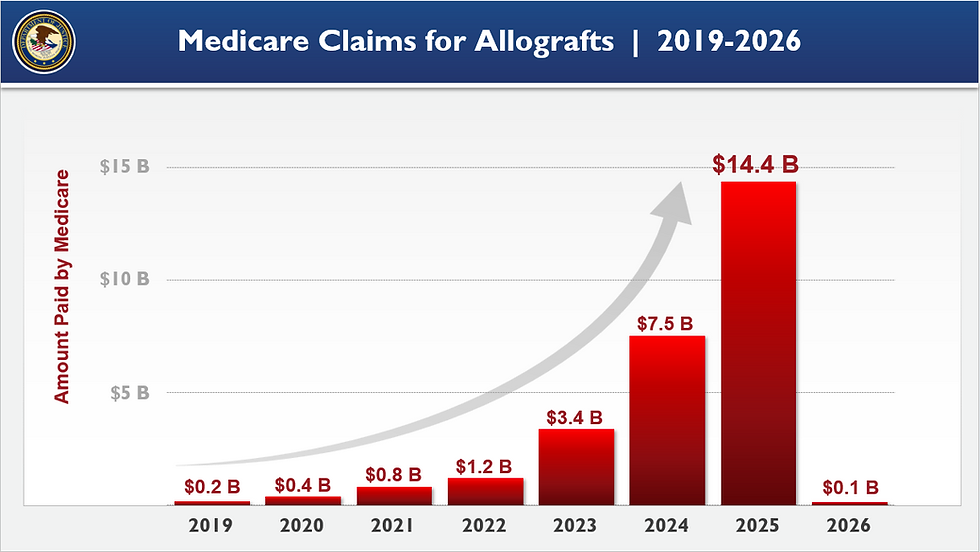
Other schemes in the sweep involved genetic-testing scams, telemedicine fraud, and the illegal diversion of prescription opioids. Knowing these patterns is half the battle — and it pairs well with understanding what "FDA approved" really means when you're evaluating any health product or claim.
What are the red flags patients can watch for?
You don't need to be an investigator to protect yourself. The single biggest red flag is anyone offering "free" medical equipment, screenings, or genetic tests in exchange for your Medicare number. Legitimate care doesn't work that way. If a call, text, ad, or door-to-door visitor pressures you to share your number or act "today only," stop and walk away — it's almost always a scam.
Watch for these warning signs:
Offers of "free" braces, test kits, or supplies that only require your Medicare number.
Unsolicited calls, texts, or emails claiming to be from "Medicare." Real Medicare will never call you out of the blue to sell you something or ask for your number.
Pressure and urgency — "this offer ends today," or "you'll lose your benefits if you don't act now."
Charges on your statements for services, dates, or providers you don't recognize.
A provider you never visited showing up on your Medicare claims.
Anyone asking you to share your Medicare number by phone, text, or email.
How can you protect yourself from Medicare fraud?
A few simple habits make you a very hard target. The Centers for Medicare & Medicaid Services recommend these steps:
Guard your Medicare number like a credit card. Only share it with your trusted providers and the people who help manage your care. Never give it out over the phone to someone who contacted you.
Read every Medicare Summary Notice (MSN). This is the statement Medicare mails you (or that you can view online) listing what was billed in your name. Compare it against the care you actually received.
Create a free account at Medicare.gov. Reviewing your claims online lets you catch problems faster than waiting for the mail.
Keep a simple care calendar. Jot down each appointment, test, or piece of equipment. Then check it against your statements — discrepancies jump right out.
Remember that Medicare won't cold-call you. If someone calls claiming to be from Medicare and asks for personal information, hang up.
Ask questions about any charge you don't understand. A trustworthy provider's office will happily explain what you were billed for and why.

How do you report Medicare fraud in Florida?
If something looks wrong, you don't have to figure out whether it's fraud on your own — just take the next step. Often, a strange charge is simply a billing mistake, so start by calling your provider's office. If it isn't resolved, or it clearly looks like fraud, report it. June is Medicare Fraud Prevention Month, and there are several easy ways to do it:
Senior Medicare Patrol (SMP) — 1-877-808-2468. This is the best first call. SMP counselors are trained specifically to help Medicare beneficiaries review statements, spot suspicious charges, and file reports. You can also reach them through the SMP Resource Center.
Medicare — 1-800-MEDICARE (1-800-633-4227).
HHS Office of Inspector General — 1-800-HHS-TIPS (1-800-447-8477) or online through the HHS-OIG fraud hotline.
Federal Trade Commission — ReportFraud.ftc.gov. If your Medicare number or identity was stolen, also visit IdentityTheft.gov for a personalized recovery plan.
Why a trustworthy provider relationship is your best protection
Here's the common thread running through almost every case in this takedown: there was no real relationship between the patient and the provider. Care was driven by billing codes, not by a doctor who actually knew the person in front of them.
The most reliable protection against fraud is the opposite of that — a provider who knows your history, explains your charges, and recommends care based on medical need. That's the heart of patient-centered care, which the Institute for Functional Medicine describes as a partnership focused on understanding the whole person rather than just running up a bill. It's a standard that any good clinic — conventional or functional — should meet.
Transparency matters here, too. When you can see exactly what a service costs and why, billing surprises mostly disappear. At Harmony Health Clinic, our functional medicine services use upfront, published pricing, and we provide superbills so you always understand what you're paying for. Legitimate telehealth follows the same principle: a real visit with your own licensed provider is the exact opposite of the "fake order" schemes in the takedown, where a patient's information was used for equipment they never requested.
If you're choosing a new provider, take your time. Our guides on how to find the right functional medicine provider and what to look for in chiropractic care for seniors in Naples can help. And you're always welcome to learn more about the team at Harmony Health Clinic before you ever book a visit.
Frequently Asked Questions
How do I know if a Medicare call is a scam?
Medicare will almost never call you out of the blue, and it will never call to sell you a plan or ask you to confirm your Medicare number. If you get an unexpected call like that, hang up. When in doubt, call Medicare directly at 1-800-MEDICARE or your local Senior Medicare Patrol to verify.
Is it Medicare fraud if my doctor made a billing mistake?
Not necessarily. Honest billing errors and clerical mistakes happen, and they're usually easy to fix. If you spot a charge that looks wrong, start by calling your provider's office — they can correct it on a later statement. If it isn't resolved or clearly looks intentional, then report it to SMP or Medicare.
What should I do if I gave my Medicare number to a scammer?
Act quickly. Contact your local Senior Medicare Patrol at 1-877-808-2468 for guidance, review your recent Medicare statements for charges you don't recognize, and report any misuse of your identity at IdentityTheft.gov. The sooner you act, the easier it is to limit any damage and protect your benefits.
Does functional medicine bill Medicare?
At many clinics, including Harmony Health, functional medicine services are typically offered on a transparent, self-pay basis rather than billed to Medicare, with superbills provided so you can seek any reimbursement you're eligible for. This upfront approach means you always know the cost in advance — there are no surprise claims filed in your name.
Can I get in trouble if someone uses my Medicare number for fraud?
Generally, victims of medical identity theft are not held responsible for a thief's fraudulent claims, but the situation still needs to be corrected to protect your benefits and medical record. Report it promptly to Medicare and your local SMP so they can flag the fraud and help you resolve it.
Take the next step toward care you can trust
You deserve a healthcare relationship built on transparency, real conversation, and decisions made for your benefit — not a billing code. If you're looking for that kind of care in Naples or anywhere in Collier County, the team at Harmony Health Clinic is here for you. Book a visit and let's talk about your health, your goals, and exactly what to expect.
Disclaimer: This article is for informational purposes only and does not constitute medical or legal advice. Always consult with a licensed healthcare professional for diagnosis and treatment. References to the 2026 National Health Care Fraud Takedown reflect allegations announced by the U.S. Department of Justice; all defendants are presumed innocent unless and until proven guilty in a court of law.


