
What Is Lab-Grown Meat? Is it Healthy?

Key Takeaways
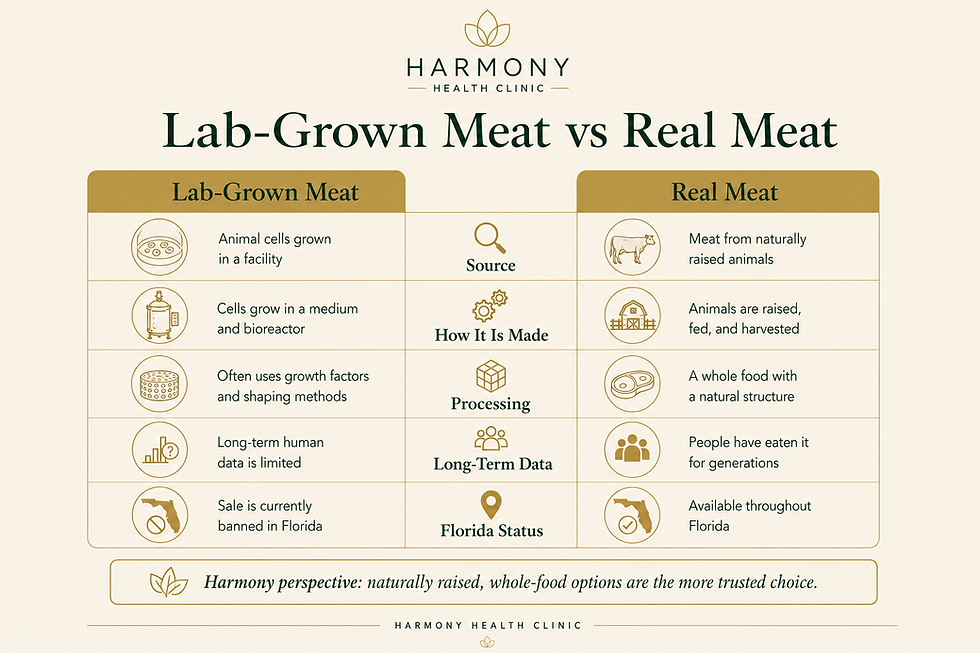
Lab-grown meat, also called cultivated or cell-cultured meat, is grown from animal cells inside large steel tanks called bioreactors. It uses a liquid growth medium instead of raising and feeding a real animal.
To grow enough cells, many producers use "immortalized" cell lines that divide without ever stopping. That trait is shared with cancer cells, and independent scientists say the long-term safety of these cells in food has not been fully studied.
No lab-grown meat product is "FDA approved" the way a medication is approved. The FDA completes a voluntary review and states it has "no further questions" about the company's own safety conclusion.
A 2023 life cycle assessment from the University of California, Davis found that, using today's methods, lab-grown meat can create four to 25 times more greenhouse gas than regular retail beef.
Florida banned the sale of lab-grown meat in 2024 under Senate Bill 1084. It cannot legally be sold in Naples or anywhere else in the state, and a federal appeals court upheld that ban in 2026.
Naturally raised, grass-finished meat is a whole food with a better fat profile and a known source, which fits a root-cause approach to health.

Lab-grown meat has moved from science fiction to real headlines. Companies now grow chicken, pork fat, and salmon from animal cells in large tanks, and a handful of these products have cleared federal review. Supporters call it the future of food and a fix for the planet.
At Harmony Health Clinic here in Naples, patients ask us a simple question: is this stuff actually good for me? That is a fair thing to ask. The honest answer is that we do not have long-term data, the process raises real concerns, and the marketing often runs ahead of the science.
This article walks through how lab-grown meat is really made, what is and is not FDA cleared, the health and environmental concerns, why Florida banned it, and why we still point our patients toward real, naturally raised meat.
What is lab-grown meat, and how is it actually made?
Lab-grown meat is animal muscle and fat grown from cells in a factory, without raising or slaughtering a whole animal. Scientists take a small sample of cells from a living animal, then feed and multiply those cells inside a bioreactor until there are enough to harvest and shape into a product like a nugget or a fillet. Here is the basic process, step by step:
First, technicians collect a tissue sample from an animal, such as a chicken. From that sample they isolate the specific cells they want, usually muscle or fat cells, or the stem cells that can turn into them.
Second, they grow those cells in a "growth medium." This is a liquid mix of sugars, salts, amino acids, vitamins, and special proteins called growth factors that tell the cells to keep dividing. In the past, many labs used fetal bovine serum, which is drawn from the blood of unborn calves. Much of the industry is moving away from serum, but the replacement growth factors are complex and expensive to make.
Third, the cells multiply inside a bioreactor. This is a large stainless steel tank, similar to the equipment used to brew beer or make pharmaceutical drugs. The tank keeps the temperature, oxygen, and nutrients tightly controlled so the cells can grow.
Fourth, the cells often grow on a "scaffold." This is an edible structure that gives the meat shape and texture, since a pile of loose cells does not look or feel like a steak.
Finally, the cells are harvested, pressed together, and processed into the final product. From cell sample to package, the whole thing happens inside a facility, not on a farm.

The immortalized cell line question
Here is a detail the marketing rarely mentions. Normal animal cells cannot divide forever. After a set number of divisions they stop, a natural safety limit called senescence. To grow meat at any real scale, that limit is a problem, because you need billions of cells.
To get around it, many producers use "immortalized" cell lines. These are cells that have been changed, either through genetic engineering or through spontaneous mutations, so they keep dividing without stopping. Growing without limit is exactly the trait that also defines cancer cells.
It is important to be precise here. Immortalization is not the same thing as cancer. Cancer involves many other harmful behaviors beyond simply dividing, and eating a cell is not the same as that cell taking over your body. Your digestion breaks food cells down into basic building blocks, and there are no documented cases of cancer being passed to a person by eating animal cells.
The real problem is what we do not know. Independent researchers and a joint report from the Food and Agriculture Organization and the World Health Organization have flagged the long-term safety of immortalized, oncogene-carrying cells in food as a genuine gap in scientific knowledge. Some experts have said it would take a 20 to 30 year study to answer the question well, which is not something anyone has done. Even the Japanese company IntegriCulture has chosen to avoid immortalized cells specifically to keep its products away from that concern. When a food is brand new and the long-term data does not exist, caution is reasonable.
“Cultivated meat has all the same fat, muscles, and tendons as any animal. … All this can be done with little or no greenhouse gas emissions, aside from the electricity you need to power the labs where the process is done.” —Bill Gates, chair of the board at Breakthrough Energy, in How to Avoid a Climate Disaster
Is lab-grown meat FDA approved?
This is where words matter, and it is a topic we cover in detail in our guide to what "FDA approved" really means. No lab-grown meat is "FDA approved" the way a new drug is approved.
For lab-grown meat, the FDA runs a voluntary "pre-market consultation." The company studies its own product, decides it is safe, and shares that data with the FDA. The FDA reviews it and, if satisfied, sends a letter saying it has "no further questions at this time" about the company's safety conclusion. In the FDA's own words, this process is not an approval. You can read the agency's position on food made with cultured animal cells and its note that the pre-market consultation is not an approval process.
For meat and poultry, a second agency also gets involved. The US Department of Agriculture inspects the facility, gives a mark of inspection, and signs off on the label. Both agencies must clear a product before it can be sold. Seafood, such as cultivated salmon, falls under the FDA alone.
So what has actually cleared this process? As of 2026, a small number of products have gone through federal review. UPSIDE Foods and GOOD Meat (owned by Eat Just) were the first, both for cultivated chicken, back in 2023. Since then, Wildtype cleared cultivated salmon, Mission Barns cleared a cultivated pork fat ingredient, and Believer Meats cleared cultivated chicken. That is roughly five products in total. Even so, clearing the paperwork has not put these foods on grocery shelves in any real way. Most have appeared only in a few restaurants, and at least one approved company shut down in late 2025.

What are the health concerns with lab-grown meat?
The biggest health concern is simple: time. Humans have eaten farm-raised meat for thousands of years. We have eaten lab-grown meat for about a decade, and only in tiny amounts. We do not have long-term studies on what happens when people eat it regularly for years. Beyond that, a few specific concerns stand out.
The growth medium itself is a question mark. It can contain growth factors, hormones, and in some cases antibiotics, all designed to push cells to multiply quickly. Companies often treat their exact recipes as trade secrets. Consumer groups such as the Center for Food Safety have pointed out that when companies will not fully disclose what goes into the product, shoppers cannot make a truly informed choice.
Nutrition is another open question. Whole meat from an animal is more than muscle. It includes fat, connective tissue, and a full package of nutrients like heme iron, vitamin B12, zinc, and creatine, built by a living body over time. Lab-grown cells grown in isolation do not automatically contain that same full profile unless it is deliberately added, and independent proof that cultivated meat matches real meat nutritionally does not yet exist. In functional medicine, we care about the whole picture of a food, not just its protein grams. If you want to understand how that whole-body view differs from the standard approach, our overview of functional medicine versus conventional medicine explains the mindset.
None of this means lab-grown meat is proven dangerous. It means the product is new, the data is thin, and several honest questions remain unanswered.
Is lab-grown meat better for the environment?
Lab-grown meat is often sold as the green choice. The claim is that growing cells uses less land, water, and energy than raising cattle. The reality is far less certain.
A 2023 life cycle assessment from the University of California, Davis measured the energy used and greenhouse gases released across every stage of production. The finding surprised a lot of people. Using the purified, pharmaceutical-grade growth medium that current methods rely on, lab-grown meat produced four to 25 times more carbon dioxide equivalent per kilogram than average retail beef.
The reason is the growth medium. To keep animal cells alive and free of contamination, the nutrients often have to be refined to the same purity level used to make medicine. Purifying ingredients to that standard takes a huge amount of energy and resources. The study also noted that adding antibiotics to the medium can push the environmental cost even higher. One of the study's authors put it plainly: cultivated meat is not automatically better for the planet, and it is not a cure-all.
Supporters point out that this was a preprint and that other studies, some funded by the industry, reach friendlier numbers. That is fair, and future technology could improve things. But the honest takeaway today is that lab-grown meat is not the clear environmental winner it is often made out to be, and the energy demand of running sterile, pharmaceutical-style factories at scale is real.
Why is lab-grown meat banned in Florida?
If you live in Naples, there is a practical bottom line: you cannot legally buy lab-grown meat here. In 2024, Florida became the first state in the country to ban it, under Senate Bill 1084. The law makes it illegal to manufacture, sell, hold, or distribute cultivated meat in the state, with penalties that can include fines, loss of a business license, and even jail time.
State leaders framed the ban around protecting Florida's farmers and ranchers and questioning whether the product was proven safe. UPSIDE Foods challenged the law in federal court, arguing it unfairly blocks interstate commerce. In 2026, a federal appeals court upheld the ban, though the broader legal fight is not fully over. Since Florida acted, several other states, including Alabama, Indiana, Mississippi, Montana, Nebraska, and Texas, have passed their own bans or restrictions.
For our patients in Collier County, the point is straightforward. This is not a food you will find at a Naples grocery store or restaurant right now, and the state has taken a firm position against it.
Why choose naturally raised meat instead?
We are big believers in real food. When it comes to protein, that means meat that came from an animal raised on a farm, ideally one you can learn something about. Naturally raised, grass-finished meat has a few clear advantages worth knowing.
Grass-finished beef tends to have a better fat profile than grain-fed beef. According to a review published in the Nutrition Journal, grass-fed beef carries meaningfully more omega-3 fatty acids and more conjugated linoleic acid, or CLA, along with higher levels of vitamin E and antioxidants. A 2026 study in the Journal of Animal Science found grass-fed beef had a much healthier omega-6 to omega-3 ratio than grain-fed beef.
We want to be honest, because that is how we practice. The absolute amount of omega-3 in any beef is still modest compared to fatty fish like salmon, so grass-fed beef is not a magic omega-3 source. But that is not really the point. The point is that whole meat from a healthy animal is a nutrient-dense food with a known origin. Beef of any kind is rich in B12, highly usable iron, zinc, selenium, and complete protein, nutrients that support energy, muscle, and hormone health. In fact, we lean on quality animal protein when we help men in Naples raise testosterone naturally.
There is also a simple wisdom in choosing food that does not need a factory, a bioreactor, and a proprietary chemical recipe to exist. We take the same careful eye to trendy processed products of every kind, which is why we wrote about whether popular swaps like oat milk are actually healthy. New and heavily marketed does not mean better for you.
What to look for when buying quality meat
You do not need to overhaul your whole kitchen to eat well. A few simple habits go a long way here in Southwest Florida.
Look for the words "grass-finished" or "100% grass-fed," which mean the animal ate grass its whole life, not just at the start. Look for "pasture-raised" for poultry and eggs. Buy from local Collier County ranchers and farmers markets when you can, since a shorter supply chain usually means fresher food and a source you can actually ask about. And remember that even conventional, minimally processed meat is a far more whole food than something engineered in a lab.
How Harmony Health Clinic can help
Food is one of the most powerful tools we have for health, and it is also one of the most confusing, thanks to endless marketing. At Harmony Health Clinic, our functional medicine team in Naples helps you cut through the noise and build a way of eating that fits your body, your labs, and your life. We look at the root causes of fatigue, weight gain, gut trouble, and hormone imbalance, and we build a real plan around real food.
If you are tired of guessing and want guidance you can trust, book a visit with our team. We would be glad to help you sort out what belongs on your plate.
Frequently Asked Questions
Is lab-grown meat FDA approved?
Not in the way a drug is. The FDA runs a voluntary pre-market consultation, then sends a letter saying it has no further questions about the company's own safety conclusion. The FDA states clearly that this is not an approval. For meat, the USDA also inspects the facility and approves the label before sale.
Is lab-grown meat safe to eat?
Regulators have cleared a few products, but honest safety questions remain. Humans have eaten it for only about a decade and in tiny amounts, so no long-term studies exist. Concerns include undisclosed growth medium ingredients and the use of immortalized cells whose long-term safety in food has not been fully studied.
Why is lab-grown meat banned in Florida?
Florida passed Senate Bill 1084 in 2024, becoming the first state to ban the sale, manufacture, and distribution of cultivated meat. State leaders said it protects farmers and consumers. A federal appeals court upheld the ban in 2026. This means lab-grown meat cannot be legally sold in Naples or anywhere in Florida right now.
Is lab-grown meat better for the environment than real beef?
Not clearly. A 2023 University of California, Davis assessment found that with today's methods, lab-grown meat can produce four to 25 times more greenhouse gas than retail beef. The energy needed to purify its growth medium is the main driver. Future technology may improve this, but it is not currently the green choice.
Is grass-fed meat healthier than lab-grown meat?
Grass-finished meat is a whole food with a known source and a better fat profile, including more omega-3s and CLA than grain-fed beef. Lab-grown meat is a new product with limited long-term data. For most people focused on real, root-cause health, naturally raised meat is the more trustworthy choice.
Disclaimer: This article is for informational purposes only and does not constitute medical advice. Always consult with a licensed healthcare professional for diagnosis and treatment.
Written by Dr. Joshua Lamers, DC & Medically reviewed by Annaelle Lamers, PA-C


